The international standard for AC duct cleaning — ASHRAE and NADCA guidance — suggests professional duct cleaning every 3–5 years for typical residential buildings in temperate climates. In Dubai, that interval is completely inappropriate.
The reasons are straightforward: Dubai’s HVAC systems operate continuously for 9–10 months of the year (versus 4–5 months for temperate heating systems). Dubai’s air contains significantly higher concentrations of fine desert silica dust than European or North American cities. Dubai’s summer humidity (70–90% RH coastal) creates condensation conditions inside duct systems that are absent in dry temperate climates. And Dubai’s ongoing construction activity across all areas of the city means most properties are exposed to construction particulate in their outdoor air.
All four factors multiply the contamination rate relative to the temperate baseline. A Dubai HVAC system accumulates more contaminant in one year than a European system accumulates in three to five years. Applying a 3–5 year cleaning interval to a Dubai property results in duct systems that are genuinely hazardous — not simply suboptimal.
This guide provides a complete, evidence-based frequency framework for Dubai AC duct cleaning — by property type, household composition, building age, proximity to construction, and seasonal considerations.
Why Dubai’s AC Systems Need More Frequent Cleaning Than Global Standards
The international baseline interval (3–5 years) is calibrated for temperate climates with specific air quality conditions. Dubai diverges from those conditions in four compounding ways:
Factor 1: Extended AC Operating Season
A typical UAE residential property operates its central air conditioning system for approximately 9–10 months per year (February or March through November or December), with some use in the remaining months for specific rooms. At a daily average of 16–18 hours of operation during peak months (June through September), total annual operating hours exceed 4,000–4,500 hours per year.
Compare this to a European heating/cooling system running 4–5 months heating (at lower hours per day) and 1–2 months cooling: approximately 1,200–2,000 total annual operating hours. Dubai HVAC systems process 2–3× more total air volume per year, accumulating proportionally more dust and biological material per year.
Factor 2: Desert Dust Concentration
Dubai’s PM10 (particulate matter ≤10 micron) concentration is significantly higher than major European cities. Dust events — ranging from mild haze to full haboob sandstorms — deposit fine silicate particles throughout the year with peaks in spring (March–May) and early autumn (September–October). These particles are in the size range (2–10 micron) that passes through standard HVAC filters and accumulates on duct walls, fan blades, and coil fins.
Every dust event increases duct contamination rate substantially. A property in a high-rise building with well-sealed windows accumulates less outdoor particulate than a ground-floor villa with older window seals — but all Dubai properties receive some dust infiltration, and it all goes through the HVAC system.
Factor 3: Construction Particulate
Dubai is one of the most actively constructed cities in the world. Construction activity generates gypsum, cement, and fine silica particulate that is present at elevated concentrations throughout the city’s ambient air. Properties within 500–1,000 metres of active construction sites receive significantly higher particulate loads — these particles clog HVAC filters more rapidly and accumulate in duct systems faster.
For properties in areas with active nearby construction (common in JVC, Dubai South, Meydan, Business Bay, and numerous other developing communities), cleaning twice per year rather than annually is strongly recommended.
Factor 4: Humidity-Driven Biological Growth
Dubai’s coastal humidity — reaching 80–90% RH in summer mornings — creates conditions for condensation on cool duct surfaces when the AC system cycles. Duct surfaces that experience repeated wet-dry cycles provide optimal conditions for mould spore germination. In properties where the AC is set very cold (20°C or below) and the outdoor air is very humid, visible condensation on duct outlet faces is possible — an extreme indicator of the moisture levels within the duct system.
Mould growth in ducts, once established, circulates spores through the air supply continuously. The summer humidity season (June–September) is the primary mould growth period in Dubai HVAC systems. A post-summer clean (October–November) specifically addresses this seasonal biological accumulation.
Recommended Cleaning Frequency – Complete Matrix
The Two-Cleaning-Per-Year Calendar for Dubai
For the majority of Dubai residential properties, a twice-yearly schedule with the two cleans timed to the UAE seasonal calendar delivers the best result:
Pre-Summer Clean (March–April)
The pre-summer clean removes the accumulated winter and spring dust and prepares the HVAC system for the most demanding 6 months of operation. March and April are peak dust event months in the UAE — clearing all accumulated material before the system enters continuous summer operation prevents that material from being circulated throughout the property during the hottest months.
This timing also allows any issues identified (filter degradation, mould early-stage signs, damaged duct sections) to be addressed before the peak demand season, when any AC malfunction is most disruptive.
Post-Summer Clean (October–November)
The post-summer clean addresses the biological accumulation from the humidity season. Six months of continuous operation through Dubai’s peak humidity period (June–September) creates the conditions most favourable for mould growth in duct systems. The October–November clean removes all biological material deposited during this period before the winter occupancy season when windows may be open and the property is more actively used.
Post-summer is also the ideal time to have the FCU/AHU unit serviced (coil cleaning, drain clearance) because the cooling season has just ended and any performance issues from coil fouling will be apparent in the summer operating record.
How to Tell It’s Time to Clean (Before the Scheduled Interval)
New Build Properties in Dubai – Cleaning Before Occupancy
New build properties in Dubai should have their AC duct systems professionally cleaned before any occupant moves in. This is non-negotiable for any building that has been through the construction and finishing process.
During construction, all ductwork is present from early in the build process — before walls, ceilings, and windows are fully sealed. Fine construction particulate (gypsum plaster dust, cement dust, drywall dust, and tile grouting dust) infiltrates all open duct runs during the construction period. Developer cleaning teams address visible surfaces but do not clean ductwork — this is not part of the handover process in any Dubai developer’s standard scope.
When the new occupant first runs the AC system, the fan disperses months of accumulated construction dust through all rooms of the new property. This is directly measurable: a white tissue held at a supply outlet in a newly delivered Dubai apartment during the first AC run will show significant grey contamination within minutes.
The pre-occupancy duct clean is the single highest-value AC duct cleaning investment for any Dubai property. It removes the construction contamination before it becomes the new baseline air quality in the home — and before it begins to settle on furniture, soft furnishings, and the personal belongings moved into the property.
Establishing a Duct Cleaning Schedule
Setting up an annual or bi-annual schedule with a licensed provider eliminates the friction of deciding when to book and ensures the service happens at the right times each year. SMS Cleaning offers scheduled AC duct cleaning plans with automatic reminder and priority booking.
- Set two calendar reminders per year: March/April (pre-summer) and October/November (post-summer)
- Keep a record of each service date — your tenancy agreement may require evidence of HVAC maintenance
- Note any issues observed by the technician at each service — this builds a history that helps identify trends (e.g. recurring mould indicating an underlying humidity problem)
- Combine AC duct cleaning with an annual deep cleaning visit to maximise efficiency — both services can be performed on the same day
- Inform your building management of any issues found in the duct system relating to communal components — their responsibility, but they need to be made aware
Get AC Duct Cleaning Services in Dubai
Professional, reliable, and fully licensed. Expert technicians with 10+ years experience.
Frequently Asked Questions
Q: How often should AC ducts be cleaned in Dubai?
Minimum once per year. Twice per year (pre-summer: March/April; post-summer: October/November) is recommended for families, properties with pets, properties near construction, and any property in Dubai’s high-humidity coastal areas. New builds should be cleaned before first occupancy.
Q: What is the ASHRAE recommendation for AC duct cleaning?
ASHRAE and NADCA guidance suggests professional duct cleaning when the system is contaminated to a level that affects performance or indoor air quality, or every 3–5 years in temperate climates. In Dubai, the 3–5 year interval is not appropriate due to the significantly higher accumulation rate from desert dust, extended operating season, humidity, and construction particulate.
Q: Is once a year enough for AC duct cleaning in Dubai?
For a standard apartment occupied by adults only with no pets and minimal nearby construction, annual cleaning is adequate. For families with children, pets, or properties near active construction sites, twice per year (every 6 months) is the appropriate standard.
Q: When is the best time to clean AC ducts in Dubai?
March/April (pre-summer): before peak demand season begins, removes accumulated winter/spring dust. October/November (post-summer): after 6 months of peak humidity operation, removes biological accumulation from the humidity season. These two timings address the two primary contamination cycles.
Q: Does a new Dubai apartment need AC duct cleaning before moving in?
Yes — strongly recommended. Construction dust from the build process infiltrates all ductwork and is not cleaned by developer teams. The first time the AC is run in a new apartment, construction particulate is dispersed through all rooms. A pre-occupancy duct clean removes this before it becomes part of the home’s indoor air.
Q: Can I clean my own AC ducts in Dubai?
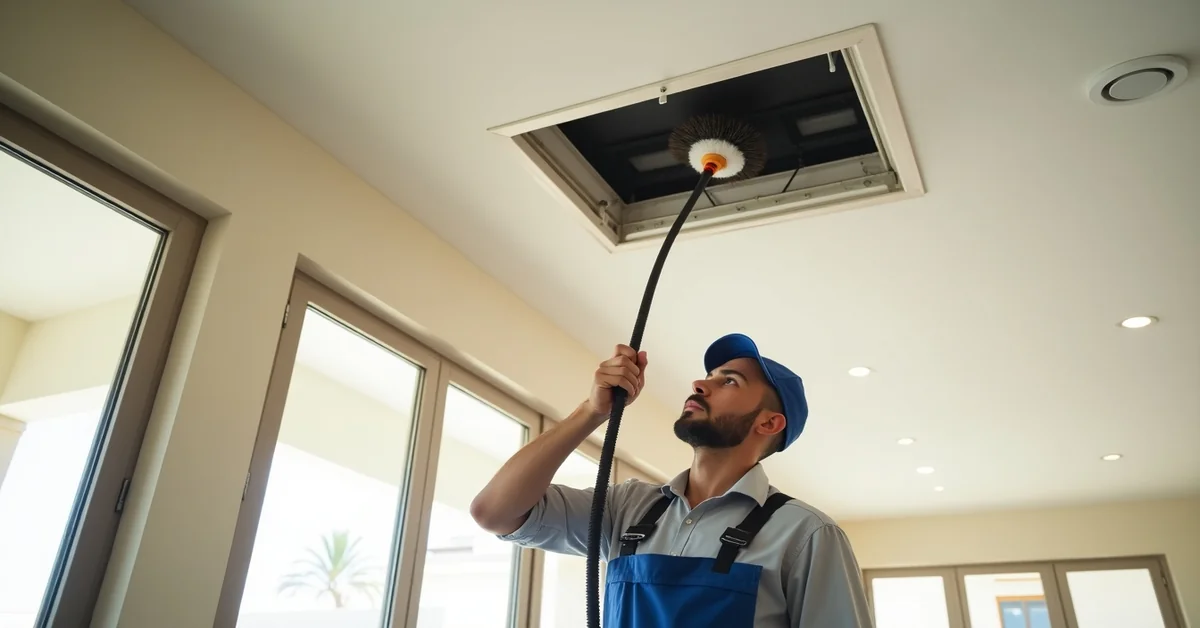
No — not to a professional standard. Professional duct cleaning requires: a high-powered HEPA vacuum system to create negative pressure; rotary brush tools for mechanical agitation inside duct runs; professional anti-mould sanitisation products; and the access knowledge to open FCU units safely. DIY approaches (compressed air, vacuum attachment at outlet) do not address bonded material inside duct walls.
Q: How does AC duct cleaning frequency affect DEWA bills?
Restricted ducts (from accumulated dust) force the system to work harder to maintain temperature — estimated 10–20% higher energy use in heavily restricted systems. Annual professional cleaning maintains near-full airflow capacity and is estimated to pay for itself from energy savings within 12–18 months for a typical 2–3 BHK property.
Next Steps
Ready to book or want to learn more? Explore these related guides:
- Signs Your AC Ducts Need Cleaning in Dubai
- AC Duct Cleaning Price Dubai – 2026 Cost Guide
- What Is AC Duct Cleaning? Full Process Guide
- Mould in AC Ducts Dubai
- Book AC Duct Cleaning Dubai
Looking for professional ac duct cleaning in Dubai?
SMS Cleaning Services – vetted, insured cleaners across Dubai & UAE.