Your AC system tells you when its ducts need cleaning — if you know what to look for. The signs range from the immediately obvious (visible grey dust shooting from an outlet when the system starts) to the subtle but significant (gradual increase in your electricity bill, or noticing your allergies are worse at home than anywhere else).
In Dubai, these signs appear earlier and more definitively than in temperate climates because of the rate at which the HVAC system accumulates contamination. A Dubai duct system that was last cleaned 18 months ago will typically show multiple visible signs. A system that has never been cleaned may be depositing years of accumulated desert dust, construction particulate, and biological growth into every room of the property.
This guide explains 15 specific signs in full diagnostic detail: what you will see or experience, why it occurs, what it tells you about the state of your duct system, and the appropriate level of urgency in response.
Critical Signs – Book Immediately
The following signs indicate a duct system contamination level serious enough to require immediate professional attention, rather than waiting for a scheduled service interval.
Sign 1: Visible Grey or Black Dust Discharging from Supply Outlets
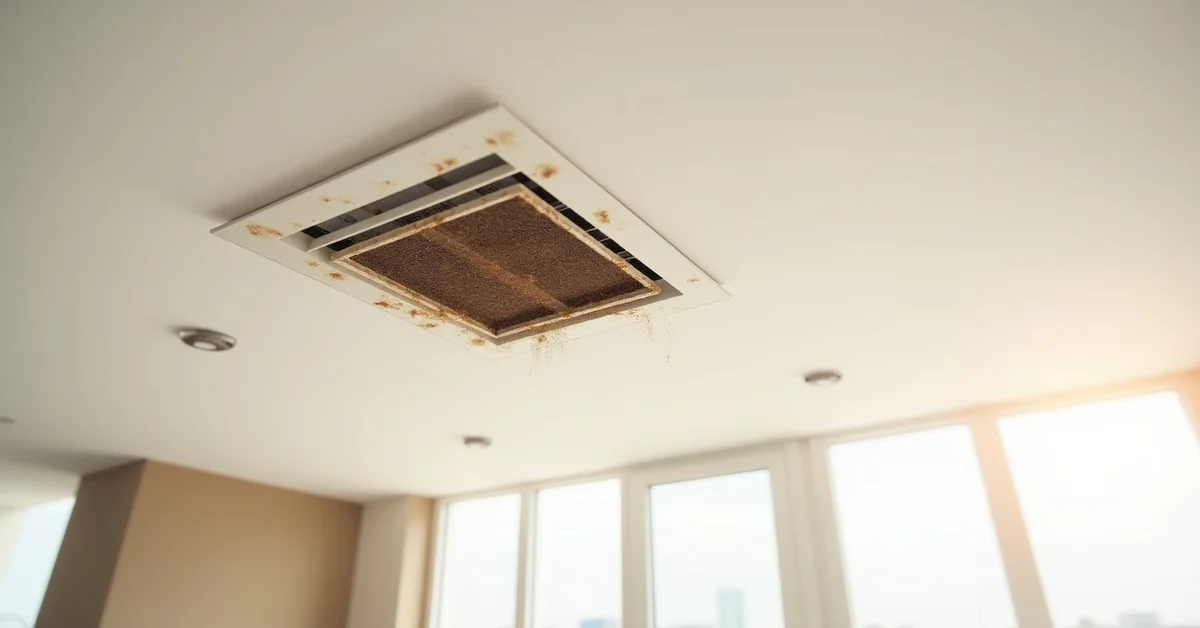
What you see: Particles of grey or black dust visibly entering the room from the ceiling/wall outlet when the AC is running. You may notice small dust particles catching the light near the outlet, or grey marks accumulating on the ceiling or wall immediately below the outlet.
Why it occurs: When accumulated dust in the duct system exceeds the adhesion capacity of the duct walls, or when a change in airflow velocity (e.g. after filter change or system restart after a period off) dislodges previously settled material, loose dust is carried by the airstream into the room.
What it means: The duct system has accumulated contamination well beyond the point at which a scheduled clean would have been due. The visible discharge is the tip of the iceberg — for every particle you see entering the room, many more are still in the duct.
Action required: Urgent booking. Do not wait for a scheduled service.
Sign 2: Musty, Stale, or ‘Damp Sock’ Smell from Outlets
What you experience: A musty, stale, or earthy odour that is strongest when the AC first starts after a period off, and reduces somewhat after the system has been running for a few minutes.
Why it occurs: This is the most reliable indicator of biological growth in the duct system. The characteristic ‘musty’ smell is produced by microbial volatile organic compounds (mVOCs) — gases released by mould colonies and bacteria as they metabolise organic material within the duct. The smell is strongest at startup because the initial high-velocity airflow disturbs and releases a concentrated burst of mVOCs from the duct surfaces.
What it means: Active biological growth (mould or bacteria, or both) is established in the duct system. In Dubai’s humid season, mould colonies can establish on duct walls within 8–12 weeks of the last cleaning if humidity conditions are right.
Action required: Urgent booking. Request specifically that the team inspect for mould and apply a full sanitisation treatment. If mould is confirmed, a specialised remediation treatment (not just standard sanitisation) may be required.
Sign 3: Visible Mould on Outlet Grills or Diffuser Faces
What you see: Dark green, black, or grey spots or film on the face of AC outlet diffusers or return air grills. In severe cases, a visible mould film extends onto the painted ceiling area immediately around the outlet.
Why it occurs: Mould grows where moisture is present. AC supply outlets in Dubai can experience condensation on the outlet face when the supply air temperature (often 14–18°C leaving the FCU) meets high-humidity indoor air. The organic dust accumulated on the outlet surface provides the nutrient substrate for mould germination.
What it means: Active mould growth at the outlet surface almost certainly indicates mould growth deeper in the duct system — the outlet is the most visible point, but the growth started inside. The mould spores circulating from this outlet are entering every room the system serves.
Action required: Urgent booking with explicit mould remediation treatment.
Strong Indicators – Book Within 2 Weeks
Sign 4: Dust Accumulating Rapidly on Outlet Grill Faces
What you see: Outlet grills collecting a visible layer of grey dust within 2–4 weeks of the last time you wiped them. If you wipe an outlet grill with a white cloth and find significant grey/black dust immediately after a recent wipe-down, the duct behind it is discharging accumulated material.
Why it occurs: As duct contamination increases, the rate at which material is discharged at outlets increases. Rapid re-accumulation on grill faces indicates heavy duct contamination.
Action required: Professional cleaning overdue. Book within 2 weeks.
Sign 5: Allergy or Respiratory Symptoms Worse at Home Than Elsewhere
What you experience: Increased sneezing, runny nose, itchy eyes, coughing, or worsening asthma symptoms that are consistently worse when you are at home — particularly in the evening or overnight when the AC is running in the bedroom.
Why it occurs: Contaminated ducts circulate allergens — dust mite colonies, mould spores, desert silica particles, pet dander — continuously through the bedroom and living areas. The ‘at home worse than elsewhere’ pattern is a reliable diagnostic indicator that indoor air quality is the trigger, which usually means the HVAC system.
Action required: Book professional cleaning. Mention the health symptoms to the technician — this helps them focus on biological contamination indicators and apply appropriate sanitisation treatment.
Sign 6: AC Not Cooling as Effectively as Before
What you experience: The property is not reaching the set temperature, or it takes noticeably longer to cool down than it did 6–12 months ago, with no change in thermostat settings or appliance load.
Why it occurs: Two mechanisms: (1) filter blockage — a fully clogged return air filter restricts airflow to the FCU, reducing the volume of air being conditioned and delivered; (2) coil fouling — a layer of dust on the cooling coil fins acts as an insulator, reducing heat transfer efficiency. Both result in the system working harder and delivering less cooling effect.
Action required: Book cleaning + combined AC service. Coil cleaning and filter replacement alongside duct cleaning will restore system performance.
Sign 7: DEWA Electricity Bill Increase Without Explanation
What you see: DEWA electricity consumption increasing over several months without change in occupancy, appliances, or usage patterns.
Why it occurs: An AC system working against airflow restriction uses more power to deliver the same output. For every 10% increase in airflow restriction from dust accumulation, energy consumption increases by an estimated 5–10%. Fully clogged filters and fouled coils together can increase energy use by 20–35%.
Action required: Book cleaning. Compare your DEWA bill for the same month in the previous year to confirm the trend. Restoration of full airflow after cleaning typically produces measurable bill reduction within the first month.
Sign 8: Uneven Cooling – Some Rooms Much Cooler or Warmer Than Others
What you experience: Noticeable temperature variation between rooms — some very cool, some stuffy and warm — with the same thermostat setting.
Why it occurs: Partial duct blockage in specific duct runs restricts airflow to individual rooms while other rooms on the same system remain normally supplied. This is more common in properties where construction dust or heavy dust events have created localised blockages.
Action required: Book cleaning with a note that you are experiencing uneven cooling — this helps the technician focus the inspection on blocked duct sections.
Moderate Indicators – Schedule Within 1 Month
Sign 9: Frequent Filter Blockage
What you notice: Your AC return air filter becomes visibly clogged within 4–6 weeks instead of the normal 2–3 months. If you are checking and cleaning your filter regularly (which is strongly recommended in Dubai) and finding it heavily loaded in under 6 weeks, the duct system behind the filter is contributing accumulated material to the airstream.
Action required: Schedule cleaning within 4–6 weeks.
Sign 10: New Property or Post-Renovation
What the situation is: You have just moved into a new Dubai property — new build or previously occupied — or you have had renovation/fit-out works done inside the property in the last 3–6 months.
Why it matters: Construction and renovation particulate infiltrates ductwork comprehensively. Even if the property appears clean on handover, the duct system contains construction dust from the build or renovation process.
Action required: Book pre-occupancy or post-renovation duct cleaning immediately.
Sign 11: Property Has Not Been Duct Cleaned in 12+ Months
In Dubai’s environment, 12+ months between cleanings is at the outer limit of the acceptable interval for standard properties and is likely beyond it for family homes, properties with pets, or those near construction. If you are not sure when the last cleaning occurred, the safest assumption is that it needs cleaning now.
Action required: Schedule a service. A professional technician will inspect and confirm the condition before starting work.
Sign 12: Condensation or Water Stains Around Outlets
What you see: Water droplets or moisture on the face of supply outlets, or yellow/brown staining on the ceiling or wall paint around an outlet.
Why it occurs: Condensation on outlet faces occurs when supply air temperature is very low and outdoor humidity is very high — creating the conditions most favourable for mould growth at the outlet surface. Brown/yellow staining around an outlet may indicate a drain pan overflow from the FCU above the ceiling void.
Action required: Book cleaning and specifically request inspection of the FCU drain tray and drain line — a blocked drain is likely causing the staining and needs to be cleared.
Context-Specific Signs – UAE Environment
Sign 13: After a Major Dust Storm or Haboob
Dubai experiences multiple dust events each year. A significant haboob (a full sandstorm with visibility reduction) deposits a large volume of fine silicate particles that infiltrate building envelopes and spike HVAC filter loading. Within 48–72 hours of a major haboob, the filter loading rate increases dramatically and visible orange-brown dust may appear at supply outlets.
Action required: Check and clean or replace filters within a week of any major dust event. If visible dust discharge appears at outlets, book professional cleaning immediately.
Sign 14: Post-Ramadan (After Intensive Cooking Period)
Ramadan in the UAE is the most intensive home cooking period of the year. Extended evening meals, multiple cooking sessions, and use of oil-heavy cooking methods produce the highest kitchen VOC and grease vapour load of any month. This load reaches the return air path and creates a grease film in ducts that holds and binds all subsequent dust accumulation.
Action required: Post-Ramadan deep cleaning and duct cleaning is the recommended annual reset for any Dubai property with intensive cooking.
Sign 15: Summer AC Shutdown (Property Left Empty)
Many Dubai families leave the emirate for 4–8 weeks during the summer peak (July–August). During this period, the AC may be left in an economising mode or shut down. When a duct system that has not been maintained sits dormant in high-humidity conditions, any existing biological growth accelerates significantly without the airflow-drying effect of the running system.
Action required: Book AC duct cleaning before resuming full occupation after a summer absence. The first full run of the system after a 4–8 week dormancy in humid conditions should be followed by a professional inspection.
False Alarms – Signs That Are Not Caused by Dirty Ducts
Get AC Duct Cleaning Services in Dubai
Professional, reliable, and fully licensed. Expert technicians with 10+ years experience.
Frequently Asked Questions
Q: What are the signs that AC ducts need cleaning in Dubai?
Key signs: visible grey/black dust discharging from outlets; musty smell when AC starts; visible mould on outlet grills; rapid dust accumulation on outlet faces; allergy/respiratory symptoms worse at home; AC not cooling effectively; DEWA bill increase; uneven cooling between rooms. Any visible dust discharge or mould sign is urgent.
Q: How do I test if my AC ducts need cleaning?
Hold a white tissue or tissue paper at a supply outlet with the AC running. If grey or black particles are visible on the tissue within 5–10 minutes, the duct system is discharging contamination and needs professional cleaning. Also check the outlet grill surface — heavy grey film within weeks of cleaning indicates active discharge.
Q: Can dirty AC ducts cause health problems in Dubai?
Yes. Contaminated ducts circulate dust mite colonies, mould spores, desert silica particles, and biological matter through the air supply continuously. The health impacts include: worsening allergy and asthma symptoms; respiratory irritation from fine particulate; headaches and fatigue from VOC accumulation; and in severe mould cases, potential mycotoxin exposure.
Q: What does mould in AC ducts smell like?
Mould in AC ducts produces a characteristic musty, earthy, or ‘damp sock’ smell — strongest when the AC first starts after a period off. The smell is caused by microbial VOCs (mVOCs) released by the mould colony. It typically reduces after the AC has been running for several minutes as the concentration disperses.
Q: How quickly do Dubai AC ducts get dirty again?
After a professional clean, visible dust at outlets should not recur within 8–12 weeks in a standard Dubai apartment. If dust is visible within 4 weeks, the duct system has a higher-than-normal contamination source — typically ongoing nearby construction, a damaged filter, or an unsealed gap in the duct system admitting unfiltered outdoor air.
Q: Is it urgent if I see black dust from my AC outlet?
Yes — book a professional service immediately. Black or very dark grey dust from an AC outlet indicates either heavy general contamination discharging or potentially mould spores being distributed through the property’s air supply. Do not continue running the system without professional inspection.
Next Steps
Ready to book or want to learn more? Explore these related guides:
- How Often to Clean AC Ducts in Dubai
- What Is AC Duct Cleaning? Process & Benefits
- Mould in AC Ducts Dubai – Full Guide
- AC Duct Cleaning Price Dubai
- Book AC Duct Cleaning in Dubai
Looking for professional ac duct cleaning in Dubai?
SMS Cleaning Services – vetted, insured cleaners across Dubai & UAE.