Mould in air conditioning ducts is not a theoretical risk in Dubai — it is a documented problem in a significant proportion of residential properties in the emirate. The conditions that produce duct mould are present in Dubai more consistently than in almost any other major city: high ambient humidity for 6+ months of the year, continuous AC operation that creates cool duct surfaces, and the organic dust load from desert particulate that provides the nutrient substrate for mould colony establishment.
Unlike surface mould on bathroom tiles — which is visible, localisable, and treatable with accessible cleaning products — mould in AC ducts is concealed inside the ceiling and wall voids, distributed across metres of ductwork, and continuously circulating its spores through the air supply to every room in the property. A resident in a Dubai apartment with active duct mould is breathing mould spores every minute the AC is running, without any visible indicator other than the characteristic musty smell.
This guide provides a complete technical and practical guide to duct mould in Dubai: how it forms, which species are present in UAE HVAC systems, the health risks by exposure level, how to identify active mould in your duct system, professional removal processes and costs, and the prevention strategy that eliminates the conditions for mould regrowth.
How Mould Forms in Dubai AC Ducts
Mould requires three conditions to grow: moisture, a nutrient source, and a surface to colonise. All three are consistently present in Dubai HVAC systems during the humidity season.
Moisture: The UAE Humidity-Condensation Cycle
Dubai’s supply air ducts carry air that has been cooled to 14–18°C by the FCU/AHU. The outdoor air in Dubai’s summer months has a relative humidity of 70–90% — carrying significant water vapour. When this warm, humid air infiltrates the ceiling void space where ducts run, it contacts the cool outer surface of the duct and, under conditions of sufficient humidity, condensation forms on the duct surface.
More significantly, within the duct itself: at locations where the duct transitions from insulated to uninsulated sections, or at joints and connections where the thermal barrier is imperfect, the inner duct surface can reach condensation point. This creates moisture directly on the interior surface where accumulated dust provides the growth substrate.
The daily temperature cycle amplifies this — cool nights (even in Dubai, nighttime summer temperatures drop to 28–32°C) combined with full-day cooling operation create repeated condensation-drying cycles on duct surfaces, alternately providing moisture (for germination and growth) and drying (which arrests growth but does not kill established colonies). Established mould colonies survive the dry periods and resume growth when humidity returns.
Nutrient Source: Organic Dust Accumulation
Mould requires organic material as a nutrient source. In duct systems, this is provided by the organic component of accumulated dust — primarily skin cells (the most abundant component of indoor dust), textile fibres, food particles carried in cooking vapour, and biological matter from occupants and pets.
In Dubai properties, cooking habits further enrich the organic duct content. Oil and food vapours that reach the return air path create a grease-oil film on duct walls, which holds all subsequent dust particles and provides an especially nutrient-rich substrate for mould growth. The combination of the physical grease film plus organic dust particles plus humidity makes duct mould in Dubai kitchen-adjacent duct runs particularly persistent.
When Mould Establishes: The Critical Periods
Mould colonies in Dubai ducts typically establish during two periods: (1) June–September — peak humidity season when condensation conditions are most frequent and most sustained; and (2) after an extended period of AC non-operation (system shutdown during summer travel, for example) when the duct system is warm, humid, and static — optimal germination conditions without the drying airflow effect of the running system.
Properties left unoccupied with the AC off for 3+ weeks during summer frequently develop active mould colonies by the time the owners return. The first AC run after such an absence disperses a concentrated burst of mould spores and mVOC gases through all rooms — the ‘musty smell on returning home from summer holidays’ that many Dubai residents recognise.
Mould Species in UAE HVAC Systems
The most commonly found species in Dubai HVAC systems are Cladosporium and Aspergillus. Both are primarily allergenic at typical exposure levels — meaning they trigger immune responses (allergy, asthma) rather than infection in healthy individuals. The risk profile changes for residents with pre-existing respiratory conditions or compromised immune systems, for whom Aspergillus species in particular carry a higher clinical risk.
Black mould (Stachybotrys) in HVAC systems is less common than in wall cavities or under flooring, because it requires sustained water saturation rather than intermittent condensation. However, it does occur in properties where FCU drain pan overflow has saturated insulation around the duct system.
Health Effects of Duct Mould in Dubai Homes
The pattern that most reliably distinguishes duct mould as the cause of health symptoms is the indoor/outdoor differential: symptoms consistently worse at home (particularly with the AC running) and improving when the resident is outdoors or in a different building. If you or a household member has this pattern, duct mould should be investigated before attributing symptoms to outdoor allergies.
Identifying Mould in Your Dubai HVAC System
Not all duct mould is visible — most of the mould in a duct system is inside the concealed ductwork, not at the visible outlet. The following identification methods range from DIY to professional.
DIY Identification Methods
- Smell test: Turn the AC off for 30 minutes, then restart and stand near a supply outlet for 60 seconds. A distinct musty, earthy, or damp smell within the first minute of startup is the most reliable DIY indicator of duct mould
- Visual check of outlet grills: Examine all supply outlet grills for dark spots, grey-black film, or any fuzzy growth. The outlet face is the most accessible visual point for mould — if visible here, it is almost certainly present inside
- Ceiling surface around outlets: Check the painted ceiling surface within 30cm of all supply outlets for any grey-brown staining, black spots, or water damage that may indicate condensation or FCU overflow
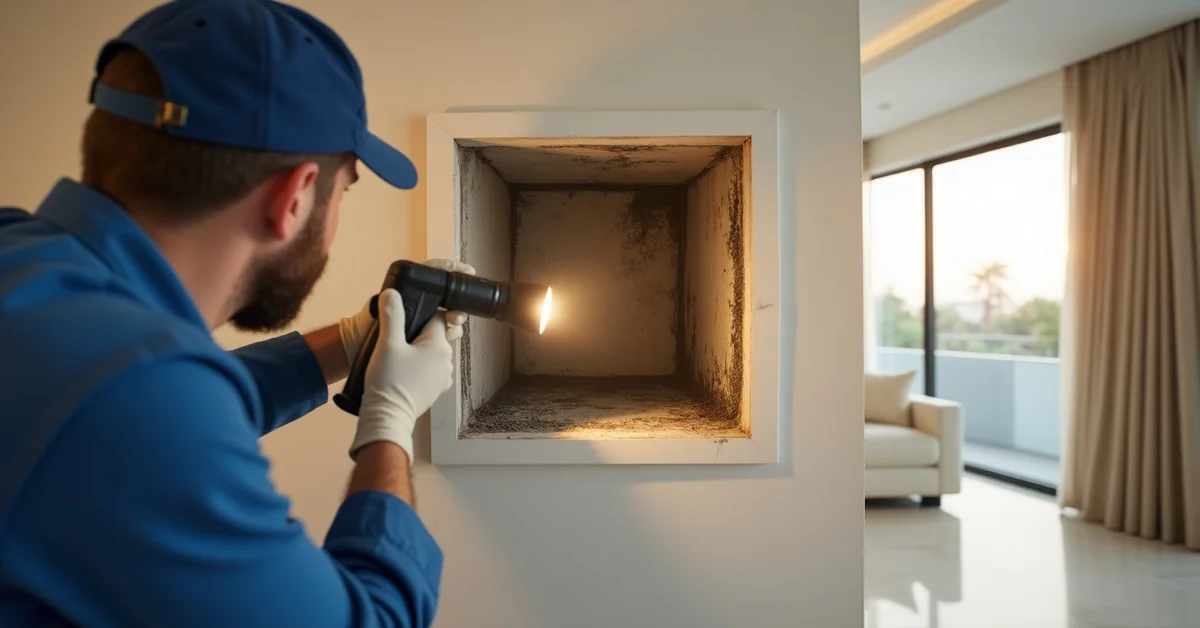
- Visual check of return air grill: Return air grills are larger and often more accessible. Remove the grill and look into the return duct with a torch — visible mould growth on duct walls within the first 30cm is a strong indicator of more extensive growth further inside
Professional Inspection and Air Quality Testing
- HVAC inspection: A professional technician opens the FCU access panel and inspects the coil, drain tray, and accessible duct sections for visible mould. The drain tray is the most common location for standing water that drives mould growth near the FCU — a professional can assess the drain tray condition and drain line clearance
- Spore trap air sampling: Air sampling devices positioned at supply outlets or in the affected rooms collect airborne particles over a set period; laboratory analysis identifies mould species and quantifies spore concentration (CFU/cubic metre). This is the definitive test for health risk assessment and useful for properties where mould is suspected but not visually confirmed
- Surface swab sampling: A swab taken from an outlet grill or accessible duct surface can be laboratory-analysed for mould species identification — useful for confirming species when black mould (Stachybotrys) is suspected due to its different remediation requirements
Professional Mould Removal from AC Ducts – Process and Cost
Standard AC duct cleaning (the rotary brush + HEPA extraction + sanitisation process) is sufficient to address early-stage mould growth — colonies that have established on dust layers in the duct but have not penetrated the duct material itself. More advanced mould growth requires an enhanced treatment protocol.
Standard Service with Anti-Mould Sanitisation
For properties with suspected or early-stage mould (musty smell only, no visible mould at outlets), the standard duct cleaning process with an enhanced sanitisation treatment is appropriate. The process is the same as described in the main duct cleaning guide, with the addition of:
- Extended dwell time for sanitisation agent (15–20 minutes versus standard 5–10 minutes)
- Repeat sanitisation treatment after initial cleaning pass
- Inspection photograph of FCU drain tray and coil surface provided
- Follow-up smell test 30 days after service recommended
Mould Remediation Treatment (Active / Visible Mould)
For properties with confirmed visible mould at outlets, musty smell persisting after standard service, or positive air quality test results:
- Application of HEPA negative air pressure before any cleaning to prevent spore dispersal into the property during the remediation process
- Enhanced chemical treatment: application of a biocide (EPA-registered anti-mould agent with dwell time per specification) to all affected duct surfaces before mechanical cleaning
- Full rotary brush + HEPA extraction process, followed by second biocide application
- Fogging of entire duct system with broad-spectrum anti-mould agent
- FCU coil and drain tray intensive treatment: drain cleared, algaecide applied to drain tray and drain pan
- Post-remediation verification: visual inspection photographs and optionally air sampling 24–48 hours after treatment
Preventing Mould Regrowth in Dubai HVAC Systems
Mould regrowth after professional remediation is common if the underlying conditions (moisture, organic accumulation) are not addressed. These prevention measures reduce regrowth risk to the minimum achievable in Dubai’s climate.
- Annual professional cleaning with sanitisation: The most effective prevention. Removes the organic dust substrate before it can accumulate to the level that supports mould growth, and applies anti-mould treatment to all duct surfaces at each visit
- Regular filter maintenance: Clean or replace return air filters on a monthly schedule in Dubai (versus the 3-month schedule recommended in cooler, drier climates). A clean filter reduces organic load reaching the duct interior
- AC thermostat setting: Setting the thermostat to 24°C rather than 20°C during high-humidity periods reduces the temperature differential between supply air and ambient air — reducing condensation tendency on duct surfaces and outlet faces
- FCU drain tray inspection: During any annual service, ask the technician to inspect and flush the FCU drain tray and drain line. A blocked drain leads to standing water in the drain tray — the most concentrated mould growth location in the entire HVAC system
- Bathroom ventilation: Bathroom extractor fans should run during and for 15 minutes after every shower. High bathroom humidity that enters the return air path is a significant mould driver in properties with open-plan layouts
- UV-C germicidal light: A permanently installed UV-C light positioned to irradiate the FCU coil surface continuously kills any biological growth that attempts to establish on the coil. Particularly recommended for properties with repeated mould recurrence or immunocompromised occupants
- Anti-humidity measures: Dehumidifiers in high-humidity rooms reduce the relative humidity available for duct condensation. Particularly useful in ground-floor units and basement apartments where ambient humidity is higher
- Never run AC below 20°C: Temperatures below 20°C dramatically increase condensation risk at outlet faces and in the supply duct sections. Most Dubai properties achieve comfort at 22–24°C; very low settings increase mould risk disproportionately
Get AC Duct Cleaning Services in Dubai
Professional, reliable, and fully licensed. Expert technicians with 10+ years experience.
Frequently Asked Questions
Q: How do I know if there is mould in my AC ducts?
The most reliable indicators: (1) musty, earthy smell from outlets when the AC starts; (2) visible dark spots or film on outlet grill faces; (3) allergy or respiratory symptoms consistently worse at home and improving when outside. A professional inspection (opening the FCU unit) and optionally air quality testing confirms the diagnosis.
Q: Is mould in AC ducts dangerous?
For most healthy adults, duct mould causes worsened allergy and respiratory symptoms. For individuals with asthma, pre-existing respiratory conditions, or compromised immune systems, the risk is higher. Aspergillus species (common in UAE HVAC) can cause serious respiratory infection in immunocompromised individuals. Black mould (Stachybotrys) produces mycotoxins that carry more serious health risks and requires full professional remediation.
Q: How much does mould removal from AC ducts cost in Dubai?
Standard duct cleaning with enhanced anti-mould sanitisation: AED 600–900 for a 2 BHK. Enhanced mould treatment (visible mould at outlets): AED 900–1,400. Full mould remediation (significant contamination): AED 1,300–2,000 for a 2 BHK apartment. Larger properties are proportionally higher.
Q: Why does my AC smell musty only at startup?
The musty smell at startup is caused by microbial VOCs (mVOCs) released by mould colonies when disturbed by the initial high-velocity airflow. After the system runs for 5–10 minutes, the concentration disperses and the smell reduces. This pattern — strong musty smell at startup, reducing after running — is the signature of duct mould.
Q: Can I use bleach to clean mould in AC ducts?
No. Bleach (sodium hypochlorite) surface-kills mould on visible, accessible surfaces but does not reach inside the duct system. It cannot be safely applied to an enclosed HVAC system without professional equipment and negative air pressure containment. Professional anti-mould treatment uses EPA-registered biocides appropriate for HVAC systems, applied with the negative pressure and fogging equipment required for duct penetration.
Q: Will mould come back after AC duct cleaning?
Without addressing the underlying conditions (moisture from condensation, filter neglect, blocked FCU drain), mould will regrow after treatment — typically within 6–18 months. Consistent annual cleaning with sanitisation, regular filter maintenance, proper thermostat settings (22–24°C rather than 18–20°C), and FCU drain inspection are the measures that minimise regrowth risk.
Q: How does Dubai’s climate cause more duct mould than other countries?
Three factors: (1) 70–90% RH summer humidity creates condensation on cool duct surfaces (14–18°C supply air meeting very humid ambient air); (2) year-round dust accumulation provides organic substrate for mould growth; (3) 9–10 months of AC operation means ducts are cool and condensation-prone for most of the year, rather than the 3–4 months typical in Europe.
Q: Should I run my AC while waiting for mould treatment?
If visible mould is at outlets and you suspect active contamination, minimise AC use before the professional treatment — running the system circulates spores through all rooms. In the interim, open windows to cross-ventilate where possible. Book the treatment urgently rather than allowing ongoing exposure.
Next Steps
Ready to book or want to learn more? Explore these related guides:
- Signs Your AC Ducts Need Cleaning in Dubai
- How Often to Clean AC Ducts in Dubai
- AC Duct Cleaning Price Dubai – Full 2026 Guide
- What Is AC Duct Cleaning? Process & Benefits
- Book AC Duct Mould Treatment in Dubai
Looking for professional ac duct cleaning in Dubai?
SMS Cleaning Services – vetted, insured cleaners across Dubai & UAE.