Steam vs dry is the most common question in Dubai sofa cleaning — and the most consequential one. Pick the wrong method and you can destroy a velvet sofa, leave a heavily soiled cotton couch only superficially clean, or end up with a sofa that takes 12 hours to dry in a humid Marina apartment when you needed it back in service for guests in 4. The fabric, the soil level, the time pressure, and the household’s allergy situation all matter.
This guide is the version of the steam-vs-dry conversation we have with first-time clients every week. It explains exactly how each method works, what it does and doesn’t extract, which fabrics each is suitable for, how drying actually works in Dubai’s humidity, and how to make the right call for your specific sofa. By the end, you’ll know which method to ask for — and you’ll be able to push back if a provider recommends the wrong one.
A quick note before we go in: in Dubai industry terminology, ‘dry cleaning’ for sofas usually means dry-foam encapsulation, not the chemical solvent dry-cleaning used for clothes. We’ll use ‘dry-foam’ throughout this guide for clarity, but if a Dubai provider quotes you ‘dry sofa cleaning’, that’s what they mean.
How Steam (Hot-Water Extraction) Works
Steam cleaning — properly called hot-water extraction — is the deepest sofa cleaning method available. A commercial extractor heats water to 60–80°C, mixes it with a pH-neutral cleaning agent, injects it into the fabric under pressure, and immediately vacuums the soiled water back out at 100+ inches of water lift. The whole cycle takes 30–60 seconds per square foot of sofa surface.
What it does: lifts embedded dust, dead skin, oils, and residue from deep inside the fabric weave; kills dust mites, bacteria, and most fungi via the heat alone; dissolves protein stains (food, sweat, blood, urine) via the dwell time of the cleaning solution; and extracts the dissolved contaminants out of the sofa rather than just spreading them around.
What it doesn’t do: clean velvet (matts the pile permanently), silk (water-marks and shrinks), or suede (turns it stiff and patchy); dry quickly (4–8 hours minimum, longer in humid Marina apartments); or fix structural sofa problems (loose seams, broken springs).
Steam Cleaning Pros
- Deepest extraction available — reaches embedded soil
- Kills dust mites, bacteria, fungi via heat alone
- Excellent on protein stains (pet, food, body fluids)
- Best for allergy / asthma households
- Refreshes long-neglected sofas more thoroughly than any other method
- Same market price as dry-foam in Dubai
Steam Cleaning Cons
- 4–8 hour drying window before sitting on it
- Risk of mould if fabric stays damp >12 hours (humid Dubai apartments)
- Damages velvet, silk, suede, dry-clean-only fabrics
- Some glued-construction microfibre sofas warp
- Heavier equipment — slightly slower setup
How Dry-Foam Encapsulation Works
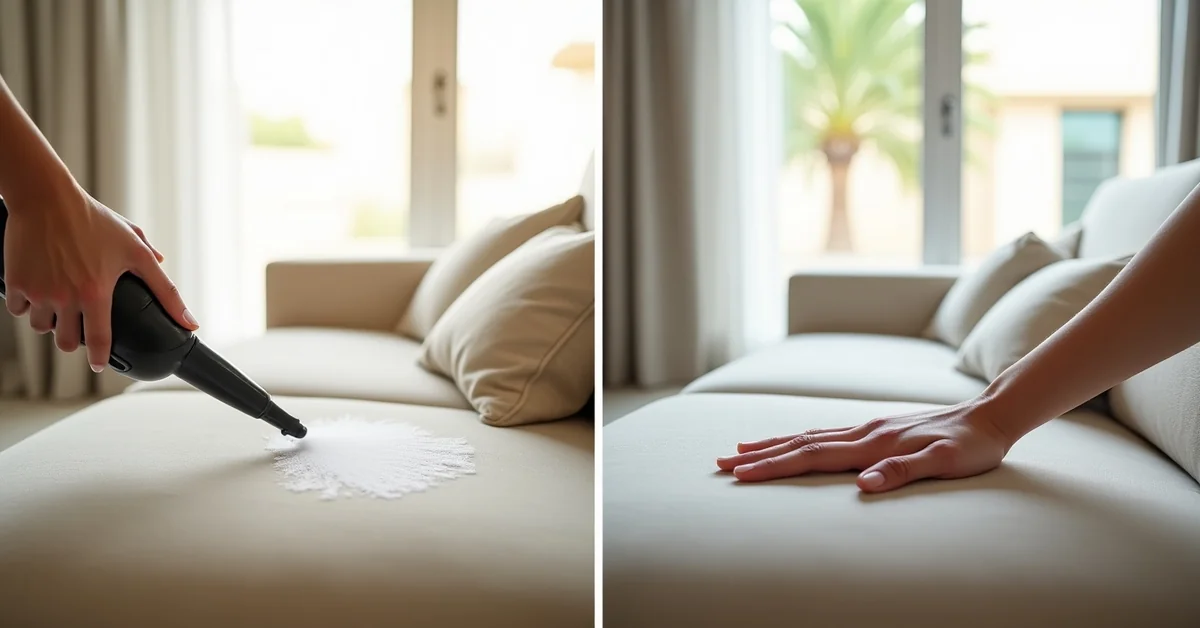
Dry-foam encapsulation uses a low-moisture cleaning foam that’s worked into the fabric with a soft-bristle brush or rotary tool. The foam binds chemically to soil particles, forms crystalline structures around them as it dries, and is then vacuumed off — taking the encapsulated soil with it. The whole process uses 80–90% less water than steam, with the rest evaporating quickly.
What it does: lifts surface and mid-depth soil; encapsulates allergens, pet dander, and dust mite waste so they’re vacuumed away; cleans delicate fabrics safely (velvet, suede, silk, faux leather); dries in 1–2 hours; and minimises water marks on water-sensitive fabrics.
What it doesn’t do: extract embedded deep soil as thoroughly as steam (typically 60–75% of what steam extracts); kill dust mites directly (encapsulates them but heat is more reliable); or handle heavy protein stains as well as steam (fresh urine or vomit benefits from full extraction).
Dry-Foam Pros
- 1–2 hour drying time — sofa back in service same morning
- Safe on velvet, suede, silk, microfibre, faux leather
- No risk of mould or water damage
- Lighter on fabric structure — older sofas tolerate it better
- Excellent for routine maintenance cleaning every 6 months
- Same market price as steam in Dubai
Dry-Foam Cons
- 60–75% of steam’s extraction depth — not as deep on heavily soiled sofas
- Doesn’t kill dust mites (only encapsulates them)
- Less effective on set-in protein stains
- Multiple passes needed for very soiled sofas (adds time)
Side-by-Side Comparison
Which Method Should You Choose? — Decision Framework
Use the rules below to make the call. They’re built from 1,000+ sofa cleanings across Dubai apartments and villas, and they hold up in 95%+ of cases. The remaining edge cases (vintage sofas, post-flood, specialty silk) need an in-person assessment.
Choose Steam (Hot-Water Extraction) If:
- Your sofa is cotton, polyester, regular linen, or standard microfibre
- It’s been more than 12 months since the last professional clean
- Someone in the household has asthma, allergies, or eczema
- You have pets and want odour and dander dealt with at the source
- There are visible food, sweat, or pet protein stains
- You can leave the sofa to dry overnight (8+ hours)
Choose Dry-Foam Encapsulation If:
- Your sofa is velvet, suede, silk, or aniline leather
- The care label says ‘dry clean only’ or ‘no water’
- It’s a glued-construction faux-leather or budget microfibre
- You need the sofa back in service within 2–3 hours
- You’re doing routine 6-month maintenance, not a heavy reset
- The apartment has very high humidity (Marina, Palm) and you want to minimise mould risk
Get an In-Person Assessment If:
- The sofa is over 10 years old or has structural damage
- It’s been water-damaged or had flood exposure
- It has heavy bleach, ink, or paint staining
- You’re not sure what fabric it is and the care label is missing
- It’s a high-value piece (designer / antique / leather over AED 30,000 retail)
How Dubai Humidity Affects the Choice
Drying time isn’t a fixed number — it depends heavily on ambient humidity, AC settings, and air movement. In a humid Marina apartment in July, a steam-cleaned 3-seater can take 8–10 hours to fully dry; in an inland Mirdif villa in February with low humidity, the same sofa dries in 3–4 hours.
If you’re booking steam cleaning in summer (June–September) or in coastal Dubai any time of year, plan for the long end of the drying range and run the AC at 22–24°C with ceiling fans on after the technician leaves. Industrial drying fans (offered as a AED 30–60 add-on) cut drying time by roughly half.
60–80% summer humidity in coastal Dubai
Drying time in Marina, JBR, Palm Jumeirah, La Mer is at the long end of the range year-round, and significantly worse in summer. Steam cleaning in these locations needs proper drying-fan support.
Source: UAE National Center of Meteorology (NCM)
Mould growth begins at 24–48 hours of damp fabric
Sofas left damp longer than 24 hours risk mould colonisation, particularly in coastal Dubai. This is why drying-fan acceleration is recommended for steam cleaning in humid apartments — and why dry-foam is the safer default for water-sensitive locations.
Source: US EPA Mold Remediation Guidelines
AC at 22–24°C reduces drying time by ~30%
Cooler AC settings drop ambient humidity faster than warmer settings. Running the AC at 22–24°C with fans is the simplest household intervention for accelerating sofa drying.
Source: ASHRAE indoor humidity research
What About Solvent Dry-Cleaning? (Less Common in Dubai)
True solvent dry-cleaning — using chemicals like perchloroethylene similar to garment dry-cleaning — is occasionally used for very delicate or vintage upholstery in Dubai, but it’s a specialist service done off-site (the cushion covers come off, go to a specialist facility, and return cleaned). It’s not the same as on-site dry-foam encapsulation.
If you have a high-value silk or vintage piece, ask specifically about solvent dry-cleaning rather than dry-foam. Most major Dubai cleaning providers don’t offer it directly but will partner with a textile specialist for the few sofas that require it. Pricing is significantly higher (AED 600–1,500+ for a sofa) and turnaround is 5–7 days.
Get Sofa Cleaning Services in Dubai
Professional, reliable, and fully licensed. Expert technicians with 10+ years experience.
Frequently Asked Questions
Q: Is steam cleaning better than dry cleaning for sofas?
It depends on the fabric. Steam is deeper and kills dust mites, making it better for cotton/polyester sofas in allergy households. Dry-foam is gentler and dries faster, making it better for velvet, suede, silk, or any sofa you need back in service quickly. Same Dubai market price for both — fabric type drives the choice, not cost.
Q: Does steam cleaning damage sofas?
Only if the wrong fabric is steamed. Cotton, polyester, microfibre, and most blends handle steam fine. Velvet (matts pile), suede (turns stiff), silk (water-marks), and some glued faux-leather (warps) should NOT be steamed. A trained Dubai technician identifies these from the care label and refuses to steam-clean them — even if the client requests it.
Q: How long after steam cleaning before I can sit on the sofa?
Wait until the sofa is fully dry to the touch — typically 4–8 hours in a Dubai apartment with the AC running, longer in humid coastal areas. Sitting too early causes water marks on some fabrics and transfers dirt from clothes back into the freshly cleaned sofa.
Q: Will steam cleaning kill dust mites?
Yes — water at 60°C+ kills dust mites and most bacteria within seconds of contact. Hot-water extraction at 60–80°C is the most effective dust-mite eradication method short of replacing the sofa. This is one of the main reasons allergy households favour steam over dry-foam.
Q: Is dry cleaning the same as solvent cleaning?
Not in the Dubai sofa-cleaning context. ‘Dry cleaning’ here usually means dry-foam encapsulation (water-based foam, encapsulation chemistry, vacuum extraction). Solvent dry-cleaning is a specialist off-site service for vintage or high-value pieces and is much rarer.
Q: Which method is safer for kids and pets?
Both are safe. Reputable Dubai providers use eco-safe, low-VOC chemistry approved for residential use. Re-entry is safe within 1–2 hours of dry-foam, or once steam-cleaned fabric is dry. Dry-foam has a slight edge if the household includes infants or pets that lick fabric, because there’s less residual moisture.
Q: Can I steam-clean my sofa myself with a rented machine?
Possible, but the result is 30–50% of professional quality at best. Domestic steam machines run at lower pressure and lower extraction lift, leaving more water in the fabric (mould risk) and extracting less soil. The chemicals available at retail are also weaker than professional formulations. For an annual deep clean, professional service is genuinely worth the difference.
Q: Do I need to do anything before the technician arrives?
Three quick prep items: vacuum off pet hair if you have heavy shedders (saves time and gets a deeper clean), remove cushion covers you don’t want cleaned, and clear a 1-metre working area around the sofa. The technician will do the rest, including a full HEPA vacuum and any pre-treatment.
Next Steps
Ready to book or want to learn more? Explore these related guides:
- Professional Sofa Cleaning Dubai – How the Process Works
- Sofa Cleaning Cost in Dubai – 2026 Price Guide
- Sofa Stain Removal Dubai – All Stain Types
- Fabric Sofa Cleaning Dubai – Linen, Velvet, Microfibre
- Leather Sofa Cleaning Dubai – Care, Stains & Conditioning
Looking for professional sofa cleaning in Dubai?
SMS Cleaning Services – vetted, insured cleaners across Dubai & UAE.